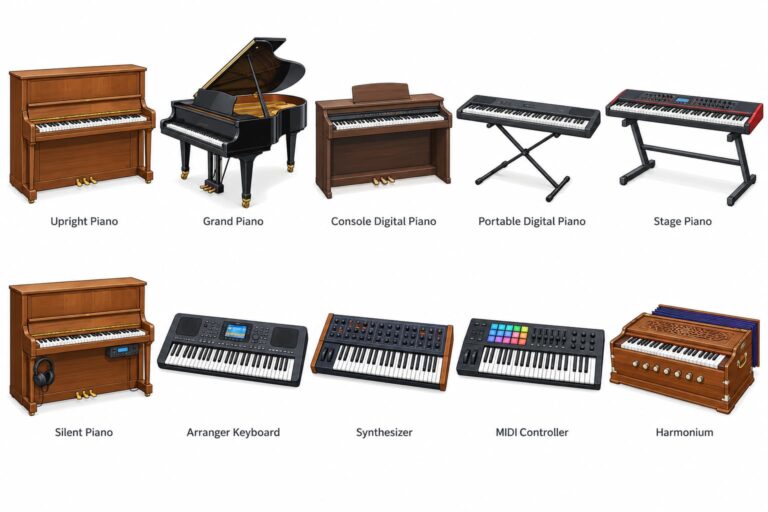
The types of pianos and keyboards available today range from a nine-foot concert grand to a pocket-sized MIDI controller, and the differences affect how you learn, practise, and perform. In simple terms, a piano makes sound with hammers striking strings, or recreates that experience digitally, while a keyboard is a broader word for any instrument played with a piano-style layout of keys. This guide explains every major category: acoustic uprights and grands, digital pianos, hybrid and silent pianos, portable keyboards, synthesizers, MIDI controllers, and other keyboard instruments. You will also learn what keys, touch, and size really mean, how to test an instrument, and which type suits which player.
Types of Pianos and Keyboards at a Glance
People use the words piano and keyboard loosely, so it helps to separate them. An acoustic piano makes sound mechanically: pressing a key moves a felt hammer that strikes a string, and a wooden soundboard amplifies the vibration. A digital piano plays recorded or modelled piano sounds through speakers or headphones, and is built to imitate the feel of an acoustic piano. A keyboard, in everyday language, is usually a lighter, more portable instrument with many sounds, while synthesizers and MIDI controllers are specialised tools for sound design and computer music.
Two terms will come up often. The action is the mechanism that connects a key to the sound, so it decides how the key feels. MIDI (Musical Instrument Digital Interface) is a standard way for instruments and computers to exchange note information. This article follows the standard twelve-note Western keyboard layout, and I will mention one important exception, the harmonium, later on.
Acoustic Pianos
Upright (Vertical) Pianos
In an upright piano, the strings and soundboard stand vertically, so the instrument takes up little floor space and fits in homes, schools, and studios. Uprights are often grouped by height: spinets are the shortest, followed by consoles, studio uprights, and full-size uprights, which are the tallest. Exact measurements differ between makers, but taller uprights generally have longer strings and a fuller bass.
Uprights usually have two or three pedals, and the middle pedal is often a practice mute rather than a true sostenuto. If pedals are new to you, our guide to piano pedals explains the differences.
Grand Pianos
A grand piano places the strings horizontally, in a wing-shaped case. Gravity helps return the hammers, and the action lets a pianist repeat a note quickly, which many advanced players value. Grands are usually named by length, although the terms are general and makers vary:
1. Petite baby grand: under about 5 feet (roughly 1.5 metres).
2. Baby grand: about 5 to 5.5 feet, and parlour grand for some slightly longer five-foot models.
3. Grand: about 6 to 6.75 feet.
4. Semi-concert grand: about 6 feet 10 inches to 7.5 feet.
5. Concert grand: typically around 9 feet.
Longer pianos generally offer longer strings, a richer bass, and more power, but they also need more space, a stable room, and regular tuning.
Early Pianos and Other Acoustic Forms
Before the modern piano, the fortepiano and the square piano were widely used, and modern replicas are still played in historical performance. Toy pianos, which strike small metal rods or bars, look like pianos but belong in a different category: they are not tuned or built like real pianos.
Digital Pianos
A digital piano is designed to give you a piano experience without strings, tuning, or a large footprint. Most have 88 keys, weighted hammer-style action, touch-sensitive keys, a headphone socket, and a volume control, which makes them popular for apartments and late-night practice.
Console (Cabinet) Digital Pianos
These look like small upright pianos, with a wooden cabinet, built-in speakers, and usually three built-in pedals. They are a good fit for a permanent spot at home.
Portable (Slab) Digital Pianos
Slim and lighter, these sit on a stand or table. They often come with a single sustain pedal, so you may need to buy a three-pedal unit separately. They suit small rooms and players who move their instrument.
Stage Pianos
Stage pianos are built for performers. They have durable bodies, many sounds, and controls for quick changes, and they often lack built-in speakers, so you connect them to an amplifier or sound system. They can also suit home players who already have speakers.
Hybrid and Silent Pianos
The word hybrid is used in two ways. It can mean a digital instrument built with an acoustic-style action, or an acoustic piano with added electronics. A silent piano is the second kind: a real acoustic piano with a silencing function. When silent mode is on, the hammers stop striking the strings, and sensors under the keys send the playing information to a digital sound module, so you hear the sound through headphones. Yamaha introduced the first acoustic piano with this feature in 1993.
Another variation uses the piano’s own soundboard as a speaker for digital sounds, so the sound comes from the wood rather than a speaker box. Hybrids can be a very good fit for families and teachers who want an acoustic touch plus quiet practice, though they generally cost more than a similar plain digital or acoustic instrument.
Keyboards That Are Not Pianos
Portable and Arranger Keyboards
Portable keyboards usually have 61 keys, a lighter key touch, and hundreds of sounds and rhythms. An arranger keyboard adds automatic accompaniment: you play chords with your left hand, and the instrument produces a band-style backing in the chosen style. They are fun and affordable, but the key feel is different from a piano.
Synthesizers and Workstations
A synthesizer makes sound from oscillators, which are the sound generators, shaped by filters and envelopes, which control how a sound starts and fades. It is built for sound design rather than imitating a piano. A workstation adds built-in recording and sequencing, so you can record, arrange, and replay performances without a computer.
MIDI Controllers
A MIDI controller makes no sound itself. It sends note, velocity, and pedal information to a computer, tablet, or sound module, which makes the sound. Many have 25 to 88 keys, plus pads and knobs. They are compact and excellent for composing, recording, and using software or browser-based music tools.
Electric Pianos, Organs, and the Harmonium
Classic electric pianos, such as the Rhodes and Wurlitzer, make sound with small struck tines or reeds and pickups, and modern keyboards often imitate them. Organs use sustained tones, and traditional organ-style instruments do not respond to how hard you press the keys. The harmonium is a hand-pumped reed instrument widely used in Indian devotional and classical vocal music. It has a keyboard, but its volume is controlled by the air pressure from the bellows, not by touch.
Keys, Touch, and Size: What the Specs Mean
Number of Keys
A standard piano has 88 keys, which is a little over seven octaves. An octave is the distance from one note to the next note with the same name. Common keyboard sizes are 88, 76, 61 (five octaves), 49, and compact 25 to 37 key controllers. A few concert grands have extra bass keys. Fewer keys are lighter and cheaper, but you may run out of notes on pieces written for the full range.
Key Action and Touch Response
Weighted keys use a hammer-style mechanism to copy an acoustic piano. Semi-weighted keys sit in the middle, and synth-action keys are light and spring-like. Touch response means a harder press gives a louder sound. Many digital pianos also grade the action, so keys feel heavier in the bass and lighter in the treble, like an acoustic piano. For learners who plan to study piano seriously, Yamaha’s beginner guide favours 88 weighted keys because they build finger strength and make a later move to an acoustic piano easier. A 61-key keyboard with a lighter touch is easier to start on, but may need technique adjustments later.
Polyphony and Sound Quality
Polyphony is how many notes an instrument can sound at once. Low polyphony can cause earlier notes to cut off when you play with the sustain pedal down. Speaker quality and headphone sound also differ a lot between models, so try both.
How to Test Any Piano or Keyboard
Here is a short beginner exercise you can do in a shop or at a friend’s house. It takes five minutes and works on any type.
1. Play a single middle C very softly, then at medium strength, then loudly. Listen for a smooth increase in volume, not sudden jumps.
2. Play the same note repeatedly, quickly and evenly. Notice whether the key returns fast enough for you to repeat without effort.
3. Hold a chord such as C–E–G and listen to it fade. A good piano sound fades gradually and naturally.
4. Play a slow C major scale at two volumes, using the hand position you would use for a real piece.
Your listening goal is even, controllable sound that responds to your touch. To check your progress, test two or three instruments in turn, write one line about each, and pick the one that gives you the most control with the least effort.
Real Musical Situations
Example 1: play the opening of a simple tune such as C–C–G–G–A–A–G, the start of Twinkle, Twinkle, Little Star, first softly and then loudly. On an acoustic or a good weighted digital piano, you can shape each note smoothly. On a light synth-action keyboard you may find it harder to control the quiet notes.
Example 2: on an arranger keyboard, turn the auto-accompaniment on and play C, F, and G chords with your left hand while you play a melody with your right. Notice how the instrument builds a full band sound from just three chords, something no acoustic piano can do.
In other settings, the picture changes. Teachers often recommend an acoustic or a weighted digital piano for serious study. Stage players prefer stage pianos for reliability. Home producers use MIDI controllers with software, and travellers appreciate compact keyboards. Schools and shared homes often choose digital or silent pianos for headphone practice.
Common Mistakes When Choosing a Piano or Keyboard
1. Choosing by sound count instead of key feel. Hundreds of sounds sound impressive, but if the keys feel like plastic switches you will struggle to control dynamics. Fix it by testing the key feel first, using the exercise above.
2. Buying a very light keyboard for long-term classical study. You may find your fingers weak or uneven when you move to a real piano. Fix it by choosing weighted keys if piano technique is your goal.
3. Ignoring space, noise, and maintenance. A grand piano that does not fit, or an acoustic piano that needs regular tuning, can become a burden. Fix it by measuring the room, asking about tuning costs, and considering a digital or silent option if noise is a concern.
Intermediate and Advanced Insights
Even an acoustic piano is not a single fixed thing. Uprights and grands differ in action, and individual pianos differ in regulation, voicing, and tuning, which means two instruments of the same model can feel different. If you practise on a digital piano but perform on an acoustic one, plan time on the acoustic piano to check pedal feel, repeated notes, and dynamic range.
A common advanced setup is a weighted MIDI controller connected to a computer running a modelled piano sound, which gives you a realistic touch, a great sound, and headphone practice. Whichever setup you use, remember that the room and speakers affect what you hear as much as the instrument does.
Do You Need an Acoustic Piano? Alternatives and Workarounds
Not necessarily. A good weighted digital piano can take most students through the early and intermediate stages, and it is easier to keep in tune and to practise quietly. If space or budget is tight, a portable digital piano with a proper stand, bench, and three-pedal unit can come close. A MIDI controller with software can also work, if you accept that the sound depends on your computer and headphones.
Acoustic pianos remain hard to replace for their natural resonance, tonal variety, and the physical feedback of strings and wood. If you have the chance, play on one regularly, even if it is a teacher’s or a friend’s piano.
Acoustic Versus Digital Pianos
1. Sound: an acoustic piano produces a complex, room-filling sound that changes with the room and your touch. A digital piano uses recordings or models, and the quality varies by model and speakers.
2. Touch: acoustic keys have natural weight and escapement feel. Digital pianos copy this, and good ones are very convincing, but they are not identical.
3. Maintenance: acoustic pianos need regular tuning and care, while digital pianos usually do not need tuning.
4. Volume control: digital pianos have headphone sockets and volume dials. Acoustic pianos are always at least moderately loud, unless they have a silent system.
5. Space and portability: uprights are large and grands are larger, while portable digital pianos are far easier to move.
6. Extra features: digital pianos can record, connect to apps, and change sounds. Acoustic pianos cannot.
Frequently Asked Questions About Types of Pianos and Keyboards
What is the difference between a piano and a keyboard?
A piano, whether acoustic or digital, is built to reproduce the sound and touch of a piano, usually with 88 weighted keys. A keyboard is a broader term. It usually means a lighter instrument with 61 or so keys, many sounds and rhythms, and a lighter touch.
In practice, the words overlap, so check the specifications: number of keys, key action, pedals, and speakers matter more than the name on the box.
Should a beginner buy a digital piano or a keyboard?
If your goal is to learn piano properly, a digital piano with 88 weighted keys and a sustain pedal is the better long-term choice. If you want a low-cost way to explore music, a 61-key keyboard is fine for a start, as long as you know you may need to adjust your touch later.
Are 61 keys enough?
For many beginner songs, chords, and melodies, yes. Much classical piano music uses a wider range, so you will eventually need more keys. Choosing 76 or 88 keys from the start avoids having to replace the instrument.
Is a grand piano always better than an upright?
Not always. Grands generally offer a longer string length, a richer bass, and a different action. But a well-made upright in good condition can be far better than a poor or neglected grand. Size, quality, and condition all matter.
What is a hybrid piano, and is it worth it?
A hybrid piano combines acoustic and digital elements. The most common example is a silent piano, where an acoustic piano can be muted and played through headphones. It is worth considering if you want a real piano feel and quiet practice, and if your budget allows.
Do I need a MIDI controller, and what else do I need to use one?
A MIDI controller is only worthwhile if you plan to use a computer, tablet, or sound module. You will need software or an app that provides the sound, a USB or MIDI cable, and headphones or speakers. Many controllers are powered over USB, so setup can be very simple.
Can learning on a digital piano prepare me for an acoustic piano?
Largely yes, if the digital piano has weighted keys and a proper sustain pedal. Expect to adjust to the heavier or different feel, the natural decay of acoustic sound, and half-pedalling. Playing an acoustic piano from time to time helps these adjustments.
Conclusion
There is no single best piano or keyboard, only the best fit for your goals, space, and budget. Acoustic pianos offer natural sound and touch, digital pianos offer convenience and quiet practice, hybrids bridge the two, and keyboards, synthesizers, and MIDI controllers serve other creative needs. Your next step is simple: test two or three instruments with the five-minute exercise above, and let the feel of the keys guide you.
 You can report directly via our Contact Form or email us at below emails.